
A World That Demands More Capital

Four years ago, we published a white paper titled A Changing Monetary Regime. At the time, inflation was widely viewed as a temporary consequence of the pandemic, and many investors believed interest rates would eventually return to the extraordinarily low levels that had defined the previous decade.
Our view was different.
We argued that several structural forces were beginning to reshape the global economy and that investors should prepare for a world where inflation and interest rates might remain higher than they had grown accustomed to. More importantly, we suggested that the previous forty years of declining interest rates may have been the exception rather than the rule.
We did not know exactly how that transition would unfold. Nor did we expect it to happen all at once. Economic regimes rarely announce themselves with a single event. Instead, conviction is built as independent pieces of evidence begin pointing toward the same conclusion.
Today, we believe Japan has become another one of those pieces.
For more than three decades, Japan stood apart from the rest of the developed world. While other economies experienced normal business cycles, Japan battled persistent deflation, stagnant growth, and interest rates that hovered near zero. Japanese households, pension funds, and insurance companies responded rationally, sending enormous amounts of capital abroad in search of higher returns. Quietly, Japan became one of the world's largest exporters of savings, helping finance governments and businesses around the globe while reinforcing an era of exceptionally inexpensive capital.
That environment is beginning to change.
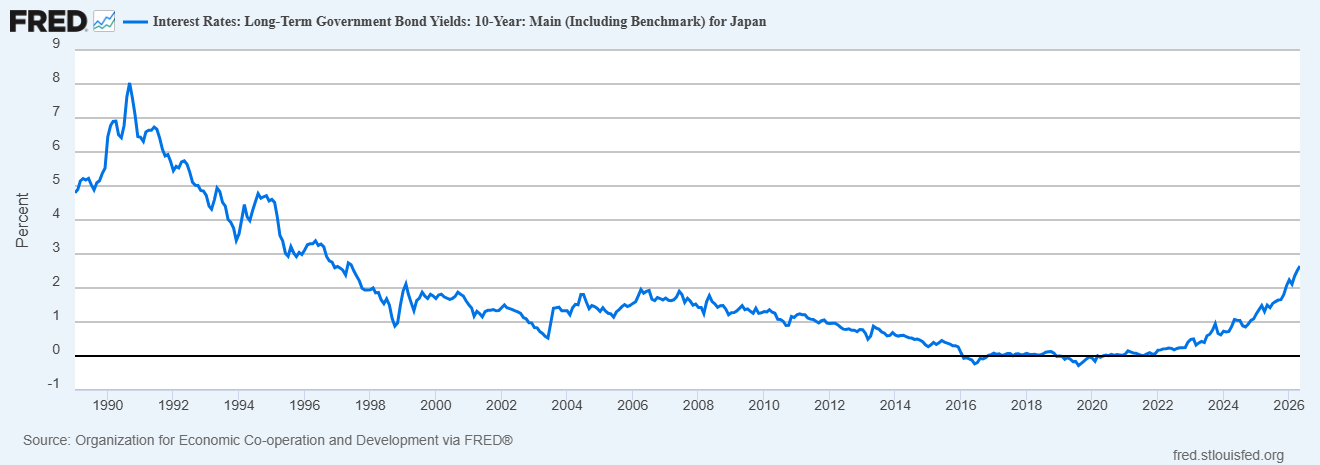
Japan has returned to inflation. Interest rates, while still modest by historical standards, have risen to levels not seen in decades. For the first time in a generation, Japanese investors can once again earn meaningful returns at home.
This does not suggest that Japan will suddenly sell its foreign investments. But the question is where the next yen will be invested.
Imagine managing a Japanese insurance company twenty years ago. A domestic government bond offered almost no return, while U.S. Treasuries or other foreign bonds provided significantly higher yields. Investing abroad was often the obvious choice. Today, as Japanese yields become increasingly competitive, that calculation is changing. The world may not experience a wave of selling, but it could gradually lose one of its most reliable sources of new capital.
That matters because interest rates are ultimately determined by supply and demand. The world is asking for enormous amounts of capital. Governments continue to finance historically large deficits. Defense spending is rising. Supply chains are being rebuilt closer to home. Energy infrastructure is expanding to meet growing electricity demand. Artificial intelligence has launched one of the largest infrastructure investment cycles in modern history. Every one of these developments competes for the same resource: capital.
This is why we have increasingly viewed today's environment through the lens of a changing regime rather than isolated economic events.
Near-shoring, persistent fiscal deficits, demographic pressures, the energy transition, and now Japan's changing monetary landscape are not disconnected stories. They all point toward the same underlying conclusion: the world is demanding more capital than it once did, while some of the structural forces that previously supplied abundant, inexpensive capital are beginning to fade.
Ironically, artificial intelligence may also become one of the greatest sources of relief. Today, AI is highly capital-intensive, requiring massive investments in semiconductors, data centers, electricity generation, and transmission infrastructure. In the years ahead, however, its productivity gains may prove to be one of the strongest deflationary forces available to the global economy. Rather than asking whether AI is inflationary or deflationary, perhaps the better question is whether its productivity gains will be sufficient to offset the broader structural forces pushing inflation and interest rates higher.
Investors often ask us whether today's interest rates are "high."
Our answer is that they are simply becoming more normal.
For much of the past forty years, investors benefited from an extraordinary combination of globalization, favorable demographics, expanding labor markets, declining interest rates, and abundant global savings. Those conditions shaped our expectations for valuations, borrowing costs, and portfolio construction. It is entirely possible that what many investors now consider "normal" was actually one of the most unusual periods in modern financial history.
If that is true, then the objective is not to predict where interest rates will be next quarter. It is to recognize that the environment in which investment decisions are made may be fundamentally changing.
That has been the foundation of our thinking for several years, and Japan is simply another example of the same forces unfolding.
Economic regimes reveal themselves slowly, one structural change at a time. We believe the evidence continues to point toward a world where capital is more valuable, interest rates are less likely to revisit the extreme lows of the last decade, and thoughtful risk management becomes increasingly important. Recognizing that shift may not tell us what markets will do next month, but it can influence how we build portfolios for the decade ahead.