
A Good Bubble?

The railroads ruined a generation of investors and built a nation. The same could be said of the early internet. In both cases, capital rushed in faster than the economics could justify, prices eventually broke, and the headlines declared a cautionary tale. What they missed was what had been left behind — infrastructure that became the foundation for everything that came next. That tension is worth keeping in mind as a familiar question resurfaces today: are we in another bubble, and if so, what does that actually mean?
That pattern has a way of repeating. And right now, it feels relevant again.
One of the more persistent undercurrents throughout all of this has been the growing conversation around artificial intelligence and the capital flowing into it. Strip away the noise, and a fair question begins to emerge. Are we in the middle of an AI investment bubble?
It’s a question we have been asking for the past year. Capital is concentrating. Narratives are tightening. Expectations are expanding quickly. Those are usually the ingredients.
But before jumping to an answer, it helps to be more precise about what we mean when we use that word.
Not all bubbles are the same.
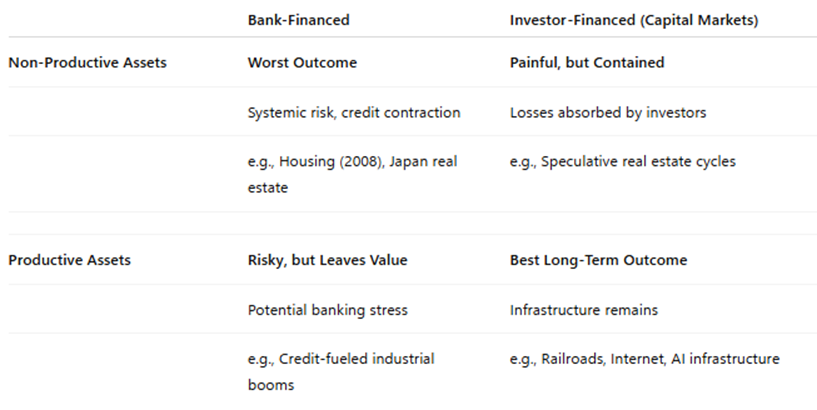
Charles Gave of Gavekal, an independent macro research firm we have followed for decades, has long framed this in a way we find particularly useful. Instead of asking whether something is a bubble, he asks two simpler questions.
What is being financed?
And who is doing the financing?
Start with what is being built.
There are investments that produce something. They generate cash flow, improve productivity, or expand the economy’s capacity. They are not always good investments at the prices people pay, but they leave something behind. Railroads did that. Telecom networks did that. The early internet did that. In each case, investors lost money when enthusiasm outpaced reality, but the infrastructure remained and became the foundation for the next phase of growth.
Then there are investments that don’t really produce anything. Their value depends mostly on what the next person is willing to pay. Land is the classic example. Real estate speculation falls into this category more often than people want to admit. So do various forms of asset hoarding. These can work for a while, sometimes longer than expected, but when they reverse, there is no underlying engine to support the price. The asset is still there, but it is not doing anything new for the economy.
That difference matters more than most people think. When a productive boom goes too far, prices correct, and the asset tends to move from speculative hands to more stable ownership, allowing for a more economic outcome. When a non-productive boom goes too far, prices correct, and there is nothing to offset the damage.
But the second question is just as important.
Who is providing the money?
When banks are at the center of the lending, the risks extend beyond the investors. Banks do not just allocate capital; they create credit. When that credit is tied to assets that fall in value, the damage shows up on bank balance sheets. Lending slows, sometimes dramatically, and the effect spreads through the economy. That is when you get a downturn that can be systemic.
We have seen that play out enough times to recognize the pattern. The housing cycle leading into 2008 is the obvious example. The issue was not just that housing prices fell. It was the banking system that had financed the rise, and when prices reversed, the system's ability to extend credit went with it.
The alternative is when the financing comes from investors rather than banks. Equity markets, venture capital, and bondholders take risks with their own capital. In those cases, losses are still losses, but they tend to be contained. The people who made the investment take the hit, new ownership often emerges at more reasonable prices, and the financial system continues to function.
That was the story of the late 1990s. There was a great deal of excess. Companies were funded that never should have been. Capital was misallocated. But when it broke, the system absorbed it. And what remained was a massive buildout of digital infrastructure that would not have happened nearly as quickly otherwise.
Put those two ideas together, and you start to see why the word “bubble” is not particularly helpful on its own.
A cycle where banks are heavily involved in lending against assets that do not produce anything tends to end poorly and linger. A cycle where capital markets fund productive investment can still be painful for investors, but it often leaves behind something useful.
That does not make it comfortable to live through. It just makes it different.
Which brings us back to where we are today.
There is clearly a large amount of capital being directed toward technology, infrastructure, and the systems supporting artificial intelligence. Prices in certain areas reflect a level of confidence that may or may not be justified in the near term. That part is familiar. Every cycle has it.
What matters more is that much of this capital is being directed toward things that, if successful, increase economic capacity. Compute power, energy infrastructure, data systems, and software layers that improve efficiency. Even if expectations overshoot reality in the short run, those investments do not simply disappear.
That does not mean there is no risk. There is always a risk when enthusiasm builds. Pricing can detach from fundamentals for a period, and when it reconnects, the path is rarely smooth.
But it does suggest that not every period of excess should be viewed through the same lens.
It also has very real implications for how investors think about protection.
When a cycle is driven by the banking system, the damage tends to be broad. When the bust comes, liquidity disappears, and the impact spreads through the entire economy. In those environments, the traditional idea of diversification often provides less protection than expected. Correlations rise at exactly the wrong time, and assets that were assumed to behave differently begin to move together. That is where overconfidence in portfolio construction tends to show up most clearly.
When the cycle is driven more by private capital, the experience is different. There can still be meaningful losses that feel widespread, but they are less likely to impair the system’s functioning. And within that, there are often areas of the market that continue to produce real economic value, somewhat independent of where the excess had built up.
That creates a more genuine opportunity for diversification. Not because risk disappears, but because it is not all coming from the same place at the same time.
This is where our current thinking sits.
We do not view the present environment as one where the most prudent action is to step broadly aside and wait in cash. That tends to be a response better suited to cycles in which risk is building within the banking system and the potential damage is systemic. We are not seeing that same dynamic today (yet).
Instead, what we are seeing is a concentration of attention. Large amounts of capital are flowing toward a specific set of themes, while other areas of the market have been relatively starved of interest. That imbalance tends to create opportunity, not just risk.
So, rather than retreat, the focus shifts to where capital is not going.
There are segments of the market that continue to produce economic value but have been overlooked as the current narrative has narrowed. (The oil and gas sector was one such area up until the recent events in the Middle East.) Those are often the areas that provide the most effective diversification when leadership eventually broadens.
Cash still plays a role, but it is part of the structure, not the strategy itself. We are currently holding roughly 10%, not as a directional bet, but as a stabilizer. It does its job by dampening volatility and giving us flexibility without stepping away from the remaining opportunity set.
Markets are not just mechanisms for pricing assets. They are also the means for directing capital. Occasionally, they overshoot in doing so. When they do, they can look like bubbles. Sometimes they are. But sometimes they are also the fastest way for an economy to build what it will need next.
The challenge is not avoiding every instance of excess. That has never been possible. The challenge is understanding what sits underneath it.
Because in the end, the damage from a cycle is not determined by how high prices went.
It is determined by what was built along the way.